NoMoreClass-Best Coaching Center in Bangalore
The Karnataka Common Entrance Test (KCET) is an entrance examination conducted by the Karnataka Examination Authority (KEA) for admission to various undergraduate courses in the state of Karnataka. The mathematics section of the KCET exam is an essential component for students aspiring to pursue engineering, architecture, and other related fields.
KCET is a state-level entrance exam held annually for admission to undergraduate courses in engineering, pharmacy, agriculture, and other disciplines offered by colleges in Karnataka. It serves as a gateway for students to secure seats in prestigious institutions across the state.
It evaluates their understanding of mathematical concepts, problem-solving abilities, and analytical thinking skills.
The paper was divided into different sections, each focusing on specific mathematical concepts.
The questions in the KCET 2020 Mathematics paper ranged from moderate to challenging, aiming to assess candidates’ depth of knowledge and conceptual clarity.
Algebraic topics included equations, inequalities, polynomials, sequences, and series.
Trigonometric functions, identities, equations, and their applications were covered extensively.
Calculus topics encompassed limits, derivatives, integrals, and their applications in solving real-world problems.
Geometry questions involved concepts related to lines, angles, triangles, circles, and solid figures.
1. If
Solution:
Answer: (c)
y= (2x)(n+1) +(3x)(-n)
⇒ dy/dx = 2(n+1)xn-(3nx)(-n-1)
⇒ (d2 y)/(dx2) = 2n(n+1)x(n-1)+3n(n+1)x(-n-2)
⇒ x2 (d2 y)/(dx2) = n(n+1) [(2x)(n+1)+3/xn ]
⇒ x2 (d2 y)/(dx2) = n(n+1)y
2. If the curves are 2x = y2 and 2xy = K intersect perpendicularly, then the value of K2 is
Solution:
Answer: (a)
2x = y2 . . . (1)
2xy = K . . . (2)
Solving (1) and (2), we get
(x,y) = (K(2/3)/2, K(1/3))
Differentiating (1) and (2) w.r.t. x
m1 = dy/dx = 1/y …(3)
m2 = dy/dx = -y/x …(4)
∵ Both curves intersect each other perpendicularly
∴m1 m2 = -1
⇒ -1/x = -1
⇒ x = 1
⇒ K(2/3) = 2
⇒ K2 = 8
3. If (xe)y = ex, then dy/dx is
Solution:
Answer: (b)
(xe)y = ex
⇒y (log x + 1) = x
⇒ y = x/(logx+1)
∴
4. If the side of a cube is increased by 5%, then the surface area of a cube is increased by
Solution:
Answer: (b)
Let one side of the cube be x and surface area be A
So, dx = 5% = 5x/100
Then, A = (6x)2
⇒dA/dx = 12x
⇒dA = (12x)dx
⇒dA = (12x) (5x/100)
⇒dA = 10A/100
⇒dA = 10%
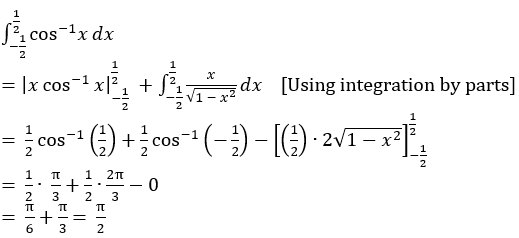
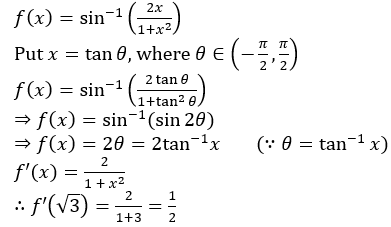
5. The value of
Solution:
Answer: (c)
6. The maximum value of
Solution:
Answer: (d)
⇒
For maxima, dy/dx = 0
⇒ 1 – loge x = 0
⇒ x = e
dy/dx changes sign from positive to negative at x = e
∴ ymax = 1/e
7. The value of
Solution:
Answer: (b)
Let t =sinx
⇒ dt=cosx dx
Therefore, I = 2∫tet dt
= 2(tet – et) + C
= 2(sinx – 1)esin x + C
8. The value of
Solution:
Answer: (c)
9. If
Solution:
Answer: (a)
Now, 3x + 1 = A(x-2)(x-3) + B(x-1)(x-3) + C(x-1)(x-2) [From eqn. (1)]
Putting x = 1, x = 2, x = 3 in the above equation one at a time, we get
A = 2, B = -7, C = 5.
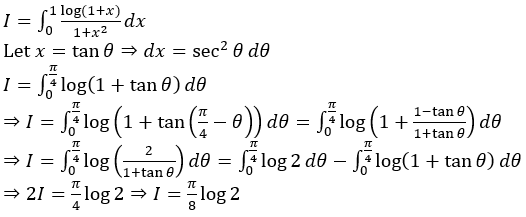
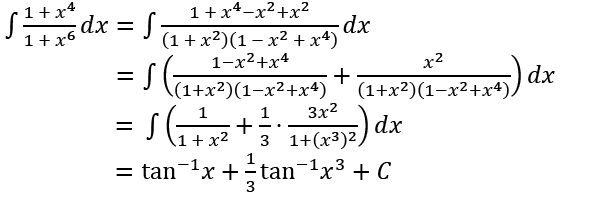
10. The value of
Solution:
Answer: (a)
11. The area of the region bounded by the curve y2 = 8x and the line y = 2x is
Solution:
Answer: (c)
Solving y2 = 8x and y = 2x, we get
(x,y) = (0,0), (2,4)
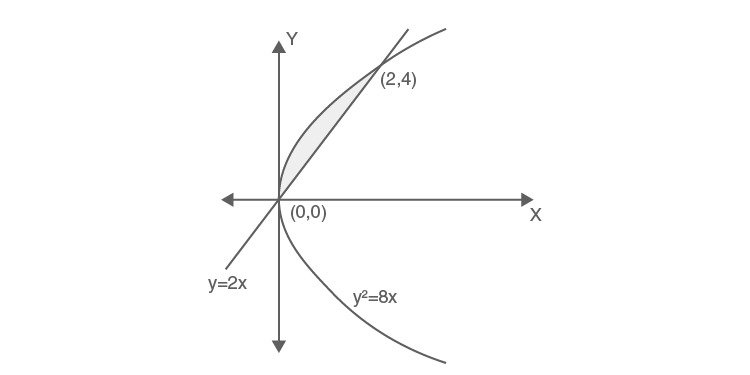
So, area bounded by the curve is

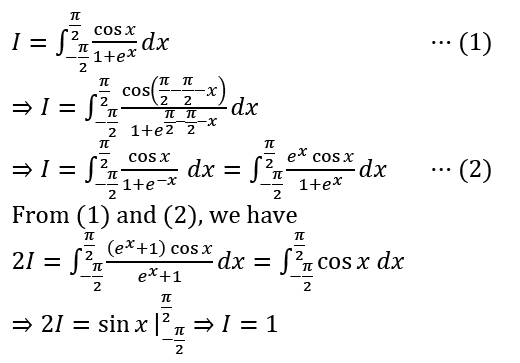
12. The value of
Solution:
Answer: (d)
13. The order of the differential equation obtained by eliminating arbitrary constants in the family of curves c1y = (c2+c3)e x+c4 is
Solution:
Answer: (b)
where A =
Order = Number of independent arbitrary constants = 1
14. The general solution of the differential equation x2dy-2xydx = x4 cos x dx is
Solution:
Answer: (b)
x2dy – 2xydx = x4 cosx dx
⇒dy/dx – 2y/x =x2 cos x
I.F. = e∫-2/x dx = e-2 logx = 1/x2
Therefore, the general solution is
∴y = x2 (sinx+c)
= x2 sinx+cx2
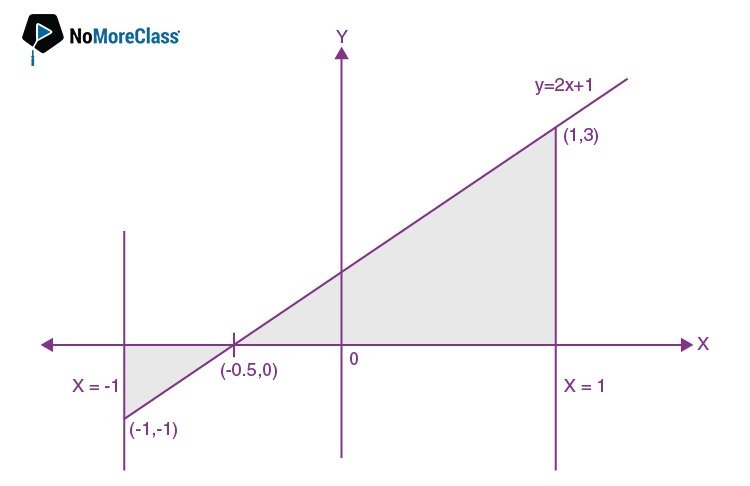
Solution:
Answer: (d)
Area bounded by y = 2x+1 with x- axis
= (1/2) (1/2)(1) +(1/2) (3/2)(3) = 5/2 sq. units.
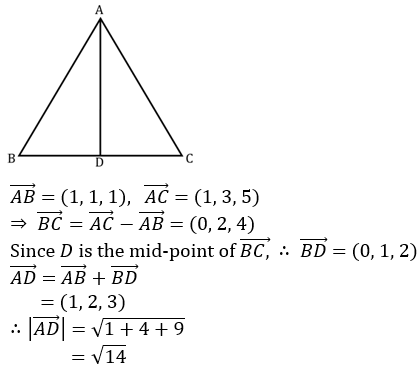
16. The two vectors
Solution:
Answer: (a)
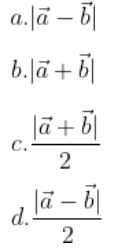
17. If
Solution:
Answer: (d)
18. The curve passing through the point (1, 2) given that the slope of the tangent at any point (x,y) is 2x/y represents
Solution:
Answer: (a)
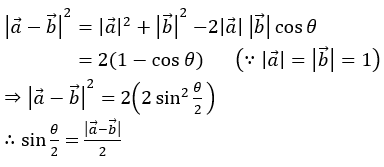
Given,
⇒ ydy = 2xdx
⇒ ∫ydy = ∫2x dx
⇒ y2/2 = x2+A, where A is a constant.
The above equation represents a hyperbola.
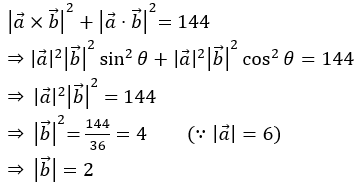
19. If
Solution:
Answer: (d)
20. The point(1,-3,4) lies in the octant
Solution:
Answer: (d)
Signs of x-coordinate, y-coordinate and z-coordinate are +,-,+ respectively.
∴(1,-3,4) lies in the fourth octant.
21. If the vector
Solution:
Answer: (b)
Given vectors are coplanar.
⇒
⇒ 2(1) + 3(4 + λ) + 4(-2 – λ) = 0
⇒ 2 + 12 + 3λ – 8 – 4λ = 0
⇒ λ = 6
22. The distance of the point (1,2,-4) from the line (x-3)/2 = (y-3)/3 = (z+5)/6 is
Solution:
Answer: (c)
Let
⇒ (x, y, z) = (2t + 3, 3t + 3, 6t – 5)
∴ d.r.’s of the line perpendicular to
and (1,2,-4) is (2t+2,3t+1,6t-1)
∴2(2t+2)+3(3t+1)+6(6t-1)=0
⇒t = -1/49
∴ Distance =
=
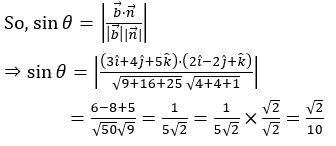
23. The sine of the angle between the straight line (x-2)/3 = (3-y)/(-4) = (z-4)/5 and the plane
Solution:
Answer: (a)
Given line is
and plane is 2x-2y+z = 5
24. If a line makes an angle of π/3 with each of x and y-axis, then the acute angle made by z-axis is
Solution:
Answer: (b)
Given, α = β = π/3
Let acute angle made by z- axis be γ.
Then,
⇒
⇒
⇒
[∵γ is acute]
25. Corner points of the feasible region determined by the system of linear constraints are (0,3),(1,1) and (3,0). Let z = px+qy, where p,q>0. Condition on p and q so that the minimum of z occurs at (3,0) and (1,1) is
Solution:
Answer: (c)
Given corner points are (0,3),(1,1),(3,0)
z = px + qy
At (3,0), z = 3p
At (1,1), z = p + q
It is given that the minimum of z occurs at (3, 0) and (1, 1)
⇒ 3p = p + q
⇒ 2p = q
⇒ p = q/2
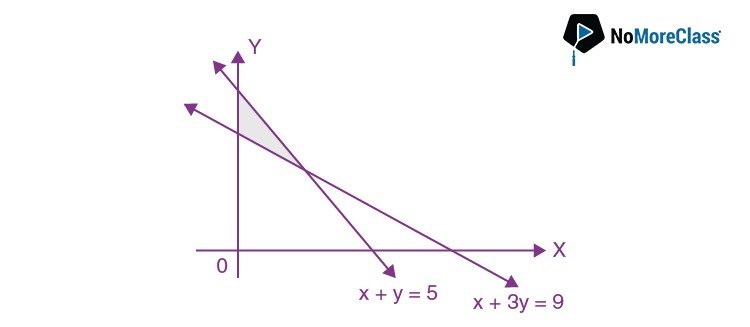
26. The feasible region of an LPP is shown in the figure. If Z = 11x+7y, then the maximum value of Z occurs at
Solution:
Answer: (a)
y-intercept of x+y = 5 is (0,5)
y-intercept of x+3y = 9 is (0,3)
The intersection point of x+y = 5 and x+3y = 9 is (3,2)
Therefore, the corner points are (0,5),(0,3),(3,2)
At (0,5), Z = 35
At (0,3), Z = 21
At (3,2), Z = 47
So, Zmax= 47 at (3,2).
27. A die is thrown 10 times, the probability that an odd number will come up atleast one time is
Solution:
Answer: (c)
Given n = 10
Probability of odd number, p = ½
∴q=1/2
Required probability = P(X≥1)
=1-P(X=0)
=
= 1 – 1/210
= 1 – 1/1024
= 1023/1024
28. If A and B are two events such that P(A) = 1/3, P(B) = 1/2 and P(A∩B) = 1/6, then P(A’|B) is
Solution:
Answer: (b)
Given P(A) = 1/3, P(B) = 1/2, P(A ∩ B) = 1/6
So, P(A’|B) = 1 – P(A|B)
=
= 1 – 1/3
= 2/3
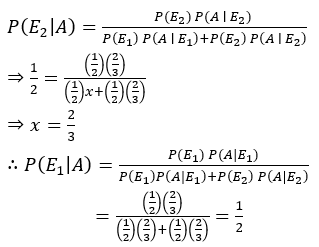
29. Events E1 and E2 form a partition of the sample space S.A is any event such that P(E1) = P(E2) = 1/2, P(E2│A) = 1/2 and (A│E2) = 2/3 . Then P(E1│A) is
Solution:
Answer: (b)
Let P(A|E1) = x
By Bayes’ theorem,
30. The probability of solving a problem by three persons A,B and C independently is 1/2,1/4 and 1/3 respectively. Then the probability that the problem is solved by any two of them is
Solution:
Answer: (c)
Required probability = P(A’BC) + P(AB’C) + P(ABC’)
= 1/2 × 1/4 × 1/3 + 1/2 × 3/4 × 1/3 + 1/2 × 1/4 × 2/3
= 1/24 + 1/8 + 1/12
=(1+3+2)/24
= 1/4
31. If n(A) = 2 and total number of possible relations from set A to set B is 1024, then n(B) is.
Solution:
Answer: (a)
n(A) = 2
Given, 2(n(A)⋅n(B)) = 1024
⇒(2)(2⋅n(B)) = (2)10
⇒2⋅n(B) = 10
⇒n(B) = 5
32. The value of sin2 510 + sin2 390 is
Solution:
Answer: (b)
sin2 51°+sin2 39°
= cos2 39° + sin2 39°
= 1
33. If tan A+cot A=2, then the value of tan4 A+cot4 A=
Solution:
Answer: (b)
tan A + cot A = 2
⇒ (tan A + cotA )2 = 4
⇒tan2 A + cot2 A + 2tan A cotA = 4
⇒tan2 A+cot2 A=2
⇒(tan2 A+cot2 A) 2=4
⇒tan4 A+cot4 A+2 tan2 A cot2 A=4
⇒tan4 A+cot4 A=2
34. If A={1,2,3,4,5,6}, then the number of subsets of A which contain atleast two elements is
Solution:
Answer: (d)
Total number of subsets of A is 2n(A) = 26 = 64
Number of subsets of A which contain at least two elements is
64-( 6C0 + 6C1 )
= 64-(1+6)
= 57
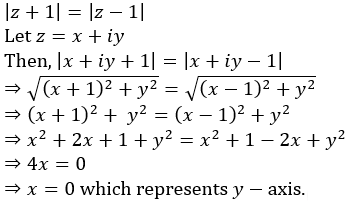
35. If z = x + iy, then the equation |z+1| = |z-1| represents
Solution:
Answer: (a)
36. The value of 16 C9+16 C10– 16C6– 16C7 is
Solution:
Answer: (b)
16C9+ 16C10– 16C6– 16C7
= 16C9+ 16C10– 16C10– 16C9=0 (∵ nCr = nC(n-r))
37. The number of terms in the expansion of (x+y+z)10 is
Solution:
Answer: (b)
Number of terms in the expansion of (x+y+z)10 is (10+3-1)C10
= 12C10=12!/(2! 10!)=66
38. If P(n) ∶2n< n!,then the smallest positive integer for which P(n)is true if
Solution:
Answer: (d)
For n = 1, 2, 3, 2n> n!
P(4) ∶ 24< 4!
So, smallest positive integer, n = 4.
39. The two lines lx+my = n and l’x+m’y= n’ are perpendicular if
Solution:
Answer: (b)
Product of slopes = -1
⇒ll’ + mm’ = 0
40. If the parabola x2 = 4ay passes through the point (2, 1), then the length of the latus rectum is
Solution:
Answer: (c)
x2=4ay
Given parabola passes through (2,1).
⇒ 22= 4a
⇒ a = 1
Length of latus rectum= 4a = 4.
41. If the sum of n terms of an A.P. is given by Sn = n2 + n, then the common difference of the A.P. is
Solution:
Answer: (d)
Sn= n2+n
S1 = 1+1 = 2 = T1
S2 = 22+2 = 6 = T1+T2
∴T2 = S2-S1= 4
Common difference, d= T2-T1
= 4-2
= 2
42. The negation of the statement “For all real numbers x and y, x + y = y + x” is
Solution:
Answer: (d)
Negation: For some real numbers x and y, x + y ≠ y + x.
43. The standard deviation of the data 6,7,8,9,10 is
Solution:
Answer: (b)
Mean,
Standard deviation,
Because,
⇒
44.
Solution:
Answer: (b)
45. If a relation R on the set {1,2,3} be defined by R = {(1,1)}, then R is
Solution:
Answer: (d)
R={(1,1)} on set {1,2,3}
Clearly, R is symmetric and transitive.
46. Let f ∶ [2, ∞] → R be the function defined by f(x) = x2-4x+5, then the range of f is
Solution:
Answer: (c)
f(x) = (x-2)2 + 1 ≥ 1, ∀ x ∈ [2,∞)
fmin = 1 at x = 2
∴ Range of f is [1, ∞)
47. If A,B,C are three mutually exclusive and exhaustive events of an experiment such that P(A) = 2P(B) = 3P(C), then P(B) is equal to
Solution:
Answer: (d)
Given, P(A) = 2P(B) = 3P(C)
⇒ P(C) = 2/3 P(B)
Since A,B,C are three mutually exclusive and exhaustive events
∴P(A)+P(B)+P(C) = 1
⇒ P(B) = 3/11
48. The domain of the function defined by f(x) = cos-1 √(x-1)is
Solution:
Answer: (b)
For f to be defined,
x -1 ≥ 0 and -1 ≤ √(x-1) ≤ 1
⇒ x ≥ 1 and 0 ≤ x-1 ≤ 1
⇒ x ≥ 1 and 1 ≤ x ≤ 2
⇒ x ∈ [1,2]
Hence, domain of f is [1, 2].
49. The value of
Solution:
Answer: (a)
π/3 ∉ [-1,1] which is the domain of sin-1 x, cos-1 x
So, cos(sin-1 π/3 + cos-1 π/3) does not exist.
Answer: (d)
Solution:
Answer: (d)
51. If A = {a,b,c}, then the number of binary operations on A is
Solution:
Answer: (a)
A = {a,b,c}
n(A) = 3
Number of binary operations is n(A)(n(A))^2 = 3(3^2) = 39

53. If f(x) =
Solution:
Answer: (d)
f(0) is the determinant of skew-symmetric matrix of order 3 (odd).
∴f(0) = 0.
54. If A and B are square matrices of same order and B is a skew symmetric matrix, then A’BA is
Solution:
Answer: (a)
B is a skew symmetric matrix.
⇒ B’ = -B
Now, (A’BA)’ = A’B'(A’)’
= A'(-B)A
= -(A’ BA)
Hence, A’BA is a skew symmetric matrix.
55. If A is a square matrix of order 3 and |A| = 5, then |A adj A| is
Solution:
Answer: (c)
|A adj A| = |A| |adj A|
= |A||A|3-1
= 5 52
= 125
56. If
Solution:
Answer: (a)
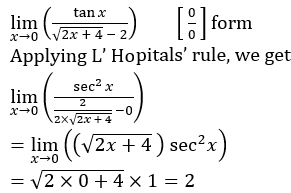
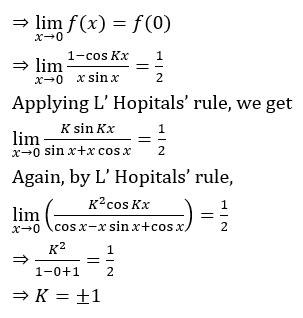
Given, f is continuous at x = 0.
Solution:
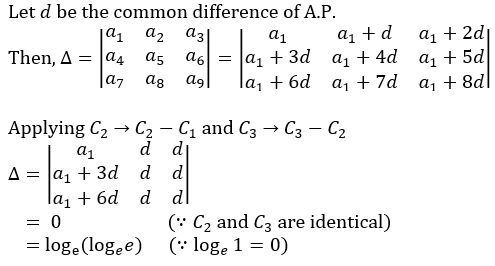
Answer: (d)
59. If
Solution:
Answer: (c)
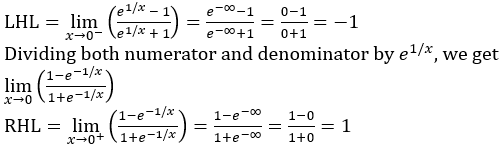
60. The right hand and left limit of the function
Solution:
Answer: (c)
Request call back
WhatsApp us